
Input data
Estimated length: the distance between the two furthest points of the section to be crossed.
Bundle diameter: the circle around all pipes pulled at once, increased by 20 %. The pipe material is usually PE or steel.
Design guide
How much room does the entry need, how steep can the bore exit and how deep can we go? These are the figures that let you draw a directional bore realistically at an early design stage.
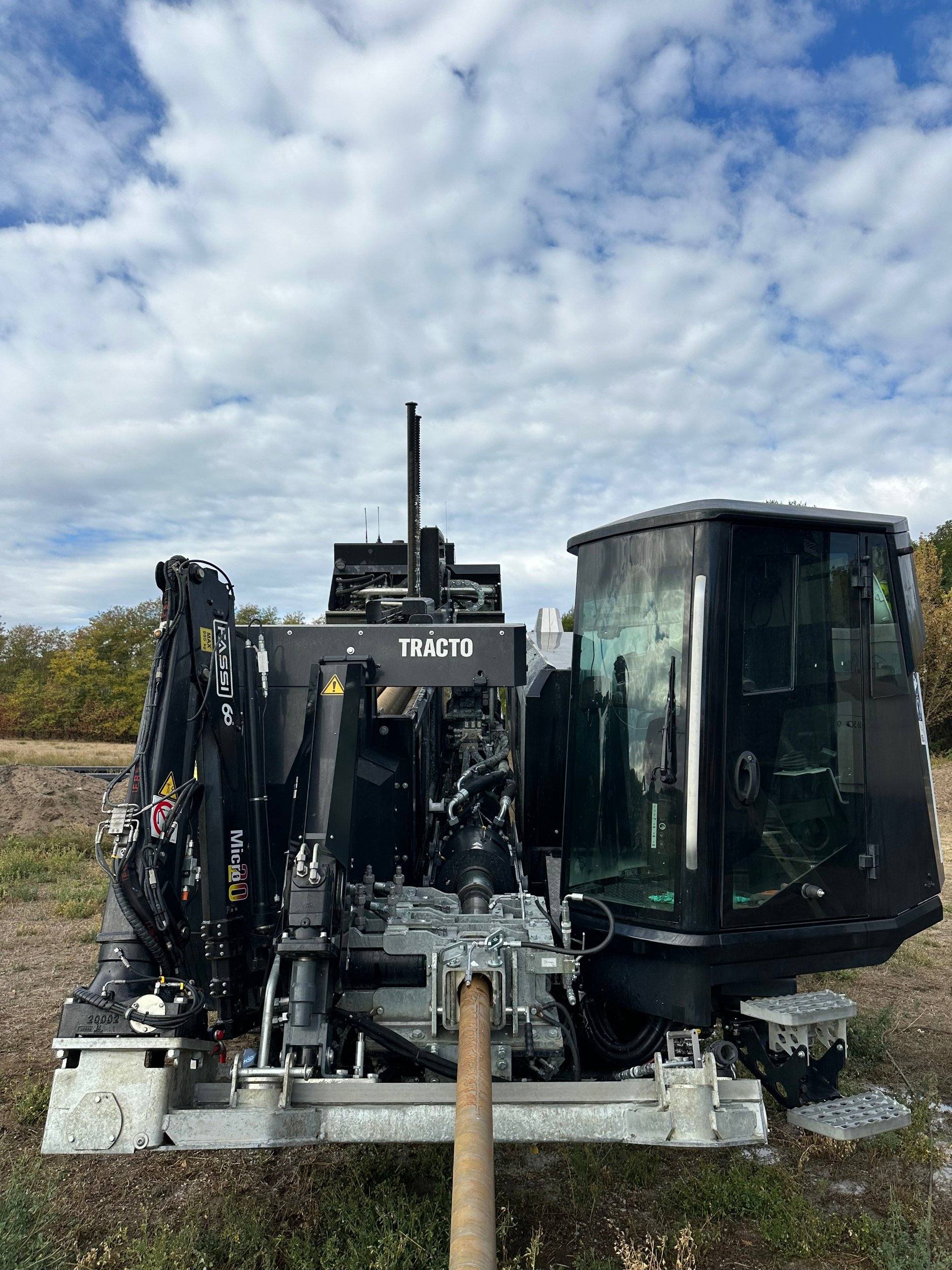
A few rules of thumb and the key data of our rigs, so that a directional bore can be drawn realistically at an early design stage. We always fix the final route after a site visit and utility coordination, and our drillers are happy to help.
30–35 % on level ground, set by the rig
100 %, the limit of the sonde in the drill head
depends on the drill rods, so on the rig size
limit of walkover tracking, depending on interference
the drill head arrives within this circle
or several pipes side by side in one bore
Route calculator
Enter what needs to be crossed and how deep. The calculator applies the rules of thumb, works out how far before and after the crossing the bore must start and end, and draws the bore axis.
Indicative calculation based on rules of thumb, not a substitute for detailed design.
Design step by step
Estimated length: the distance between the two furthest points of the section to be crossed.
Bundle diameter: the circle around all pipes pulled at once, increased by 20 %. The pipe material is usually PE or steel.
Length and diameter determine the rig. For PE pipe the arc radius is the smallest bend radius of the drill rods, 25 to 140 m on our rigs.
For steel pipe the bending of the pipe itself governs. If it is unknown, a good approximation is a radius in metres equal to the pipe diameter in millimetres (Ø 500 mm, about 500 m). For thick-walled coated pipe the factor can be 1.3. If the pipe curves horizontally and vertically at the same time, both projections must be much larger.
A rig can be inclined to 17–19° (30–35 %) at most, which is the largest entry angle. The sonde in the drill head measures up to 45° (100 %), which is the steepest exit, though flatter is of course possible.
Because of walkover tracking the deepest point can be 12–15 m, depending on interference. From the radius, the two angles and the depth the axis can be built from arcs and straight sections, and the calculator above does exactly that.
With uncertain utility positions the bore length can change considerably, since a site visit often shows a line is not where the drawing puts it. Trial pits may then be needed.
Depending on the rig, about 4.5–12 m length and 1.5–3.5 m width of clear space is needed in the bore axis, and our largest rig, the Prime Drilling, needs more preparation. Anchors are driven 1 m deep in front of the rig.
The mixer truck (12–20 t) can stand at most 50 m from the rig because of the mud hose and control cable. On the exit side there must be room for the laid out pipe, welded there if needed, otherwise a road crossing, for example, cannot be done.
Pits must not obstruct the bore. The entry pit should not be too long, because rods hanging free without lateral support buckle and the thrust of the rig is lost.
Frequent questions
Only to collect the drilling fluid used during the bore. If that is not needed on the site, no pits are needed either.
A soil displacement hammer is different: it always needs entry and exit pits, as deep as the object has to be crossed.
No. The drill head starts at about 15° and is turned horizontal on an arc of at least 25 m radius. That needs at least 10 m, plus about 5 m for the rig itself.
Yes. We know the position of the drill head at every moment and can steer it in any direction, within the bending limits of the spring steel rods and what the soil allows. Please agree the amount of lateral curve with our drillers.
The entry angle is set by the rig, usually 30–40 % on level ground, about 15–20°. It can be increased by setting the rig on a slope.
The exit is limited to 100 % (45°), because the transmitter in the drill head does not measure steeper.
Within the bending limits of the rods yes, even with lateral curves. In practice the required clearances rarely allow it.
The drill head usually arrives within a circle of 40–50 cm. If a more precise connection is needed, it is best to start from that side if the site allows.
The axes should be about 1 m apart. Several pipes can also be pulled tightly together into one bore.
Send us the route or the site plan, and our driller will tell you which rig and which arc will work best.